
01 / Form8 min
Read a vessel by profile
Trace rim, neck, shoulder, body and base before assigning function or date.
Open note →An Egyptian ceramic field journal
A ceramic object records choices in profile, wall, surface and firing. A responsible reading keeps modern workshops, excavated fragments and museum vessels in their own contexts.
Four clay notes
The notes move between museum objects and a contemporary Fayoum workshop without claiming that every technique or motif belongs to one continuous practice.
Trace rim, neck, shoulder, body and base before assigning function or date.
Open note →
Separate body, glaze, metallic-looking decoration, wear and museum lighting.
Open note →Read tools, work surfaces, drying, display and consent without staging production.
Open note →
Follow zigzag panels around a museum jar without inventing a symbolic reading.
Open note →
The five-part profile
Read the opening, lip and immediate change below it. A rim fragment can preserve form even when the full vessel is missing.
Look for the transition from narrow opening to wider body. Not every vessel has a distinct neck or sharp shoulder.
Find the widest point and the curve above and below it. Camera perspective can distort this relationship.
Observe foot, rounded bottom or support only when visible. Display mounts can hide the original contact point.

Field principle
Ask before entering, photographing people, touching objects or recording a process. Displayed work, drying pieces and tools remain under the maker’s control.
Do not request that someone repeat a risky, messy or time-sensitive action for a photograph. A quiet frame of space and materials can be more accurate.
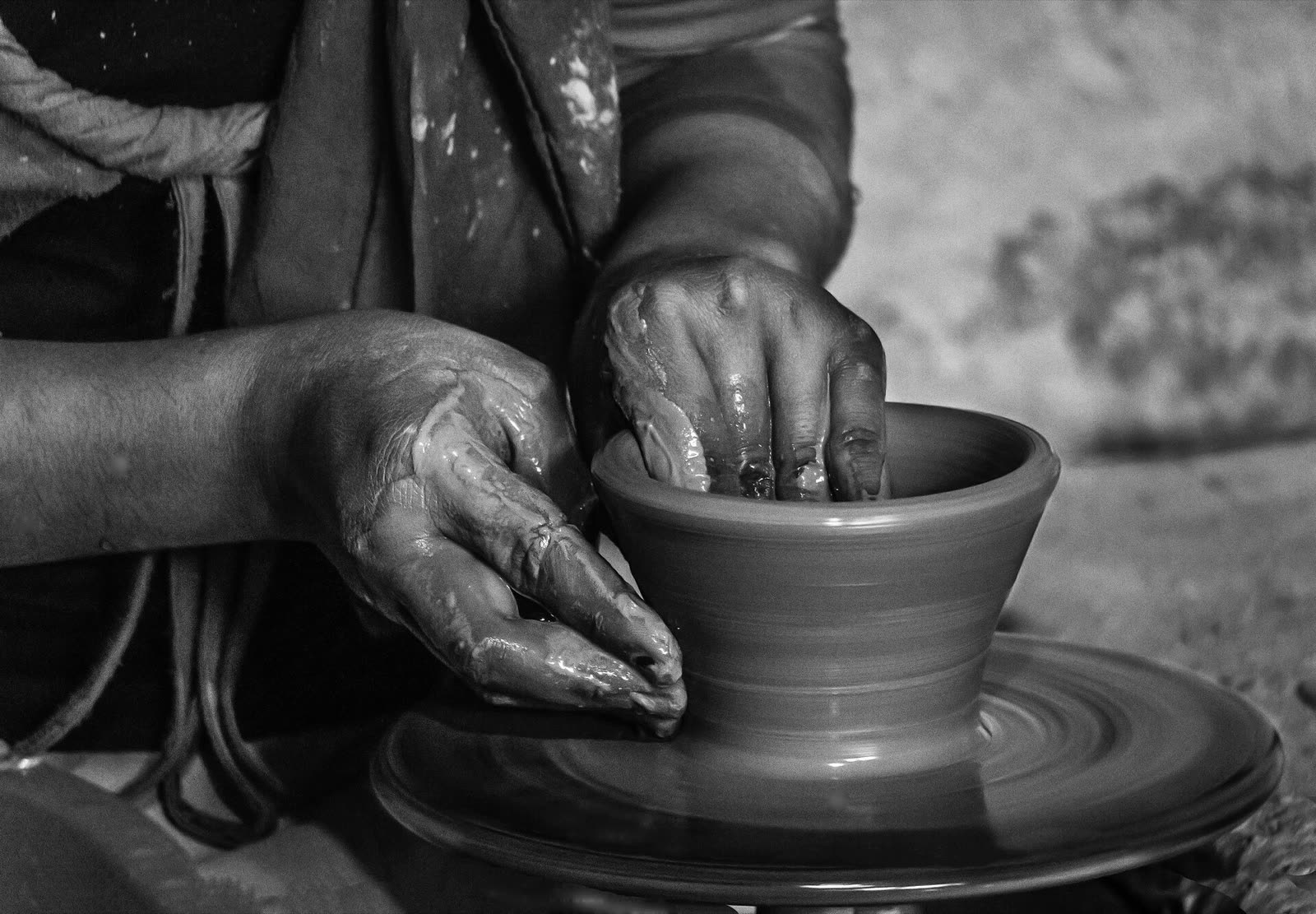
Eveline Pottery School, Fayoum. Photo: Mohamed Ahmed Hassan, CC BY-SA 3.0.
Use the workshop guide