Note 03 / contemporary making
Tunis village: workshop in context
A workshop photograph may show several stages at once. Read work zones and visible material carefully without reconstructing a universal process.
.jpg)
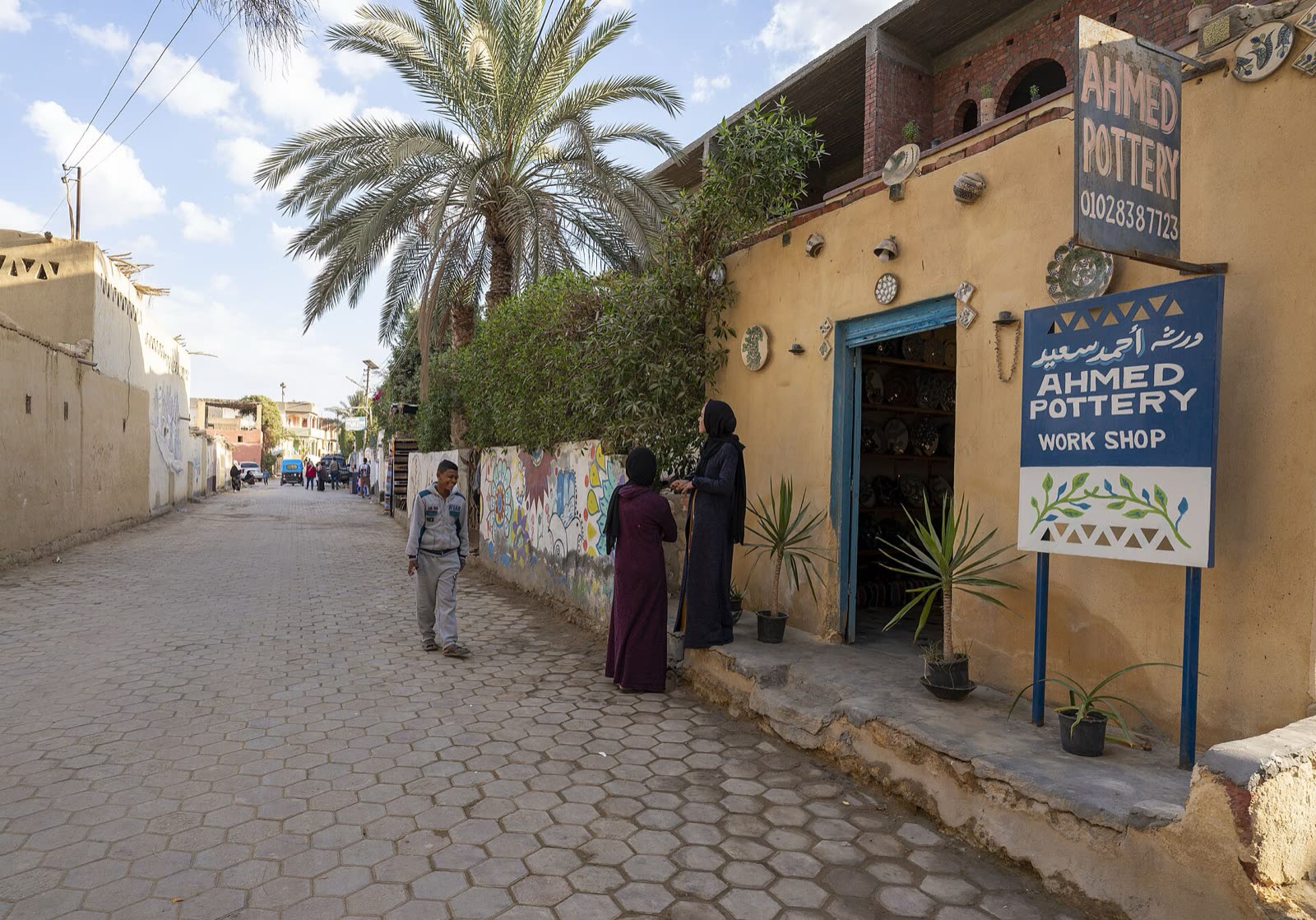
The source identifies this scene as Ahmed Saeed Pottery Workshop in Tunis village, Fayoum. That named contemporary setting matters. It is not a generic reconstruction of “Egyptian pottery through the ages,” and the objects visible in one photograph do not document every stage of their manufacture. A useful field note begins with access and spatial organisation before attempting to describe technique.
Confirm whether the space is open
A workshop may also be a school, shop, storage area or private working environment. An open doorway or public reputation does not make every room available. Ask a responsible person before entering, moving closer, photographing or recording. Follow the route offered and accept that active work may limit the visit.
Map work zones without crossing them
Look for clay preparation, forming, drying, surface treatment, firing-related areas, storage and display only when visible. Tools, water, cables, shelves and fragile greenware can create hazards that a visitor does not recognise. Stay outside the maker’s route and do not step backward while looking through a camera.
Workshop map
Visitor position → active hands → wet or unfinished objects → drying or storage → finished display. Use question marks rather than naming a kiln, clay type or process that is outside the frame.
Wet clay records immediate pressure
Hands can compress, pull, join, smooth or mark clay, but a still image captures one instant. A finger position does not establish the full forming method or sequence. Describe the visible contact and object state. If the maker explains a technique and permits attribution, record the explanation as theirs rather than a rule for all workshops.
Tools need context
A bowl of water, wire, scraper, brush, wheel or mould may support different tasks. Location on a table does not prove current use. Avoid picking up a tool or moving it beside an object to make the relationship clearer. A clean photograph of separate items is more truthful than an arranged false process.
Drying is an active stage
Unfired work can look complete while remaining vulnerable to touch, rapid movement and changing humidity. Shelves may organise pieces by stage or simply by available space. Never test dryness, rotate a vessel or remove dust. Ask which objects may be handled, if any.
Visible colour before firing may differ from the finished surface. The photograph cannot guarantee the final colour, glaze or survival of an object.
Firing stays outside casual inference
Finished pots prove that firing occurred, but they do not identify kiln type, temperature, fuel, atmosphere or firing schedule. Those are technical facts. Record a kiln only if it is safely visible and the responsible person allows it; do not approach a hot, closed or work-restricted firing area.
Display and production can overlap
Objects offered for viewing or sale may stand beside works in progress. Ask before handling both. A price or displayed group does not establish maker identity, material source or production date. If considering a purchase, request information directly and keep the answer attached to that specific object.
Photograph people with specific consent
Permission to photograph a room does not automatically cover an identifiable maker, student or child. Explain the intended frame and likely publication. Do not ask someone to restart a wheel, repeat a cut, hold wet clay longer or perform an action for drama. Show the frame when requested and respect withdrawal before use.
Avoid the word “unchanged”
Contemporary workshops combine learned practice, individual design, available materials, education, markets and changing tools. Resemblance to museum pottery does not prove direct continuity. Describe today’s vessel on its own terms and use historical comparison only when research or the maker supports it.
Leave the workspace as found
Do not collect clay, fragments, test tiles or discarded-looking material without an explicit offer. Keep food and drink away from work surfaces, carry out litter and finish the visit when production or instruction needs the space back.
A workshop becomes more legible when the visitor accepts its limits. The position of hands, shelves and objects reveals a present system of making. Respect keeps that system intact.