Note 04 / pattern and record
Painted jar: pattern around form
The zigzag panels are easy to name and difficult to interpret. Begin with their position, repetition and relationship to the vessel’s curve.
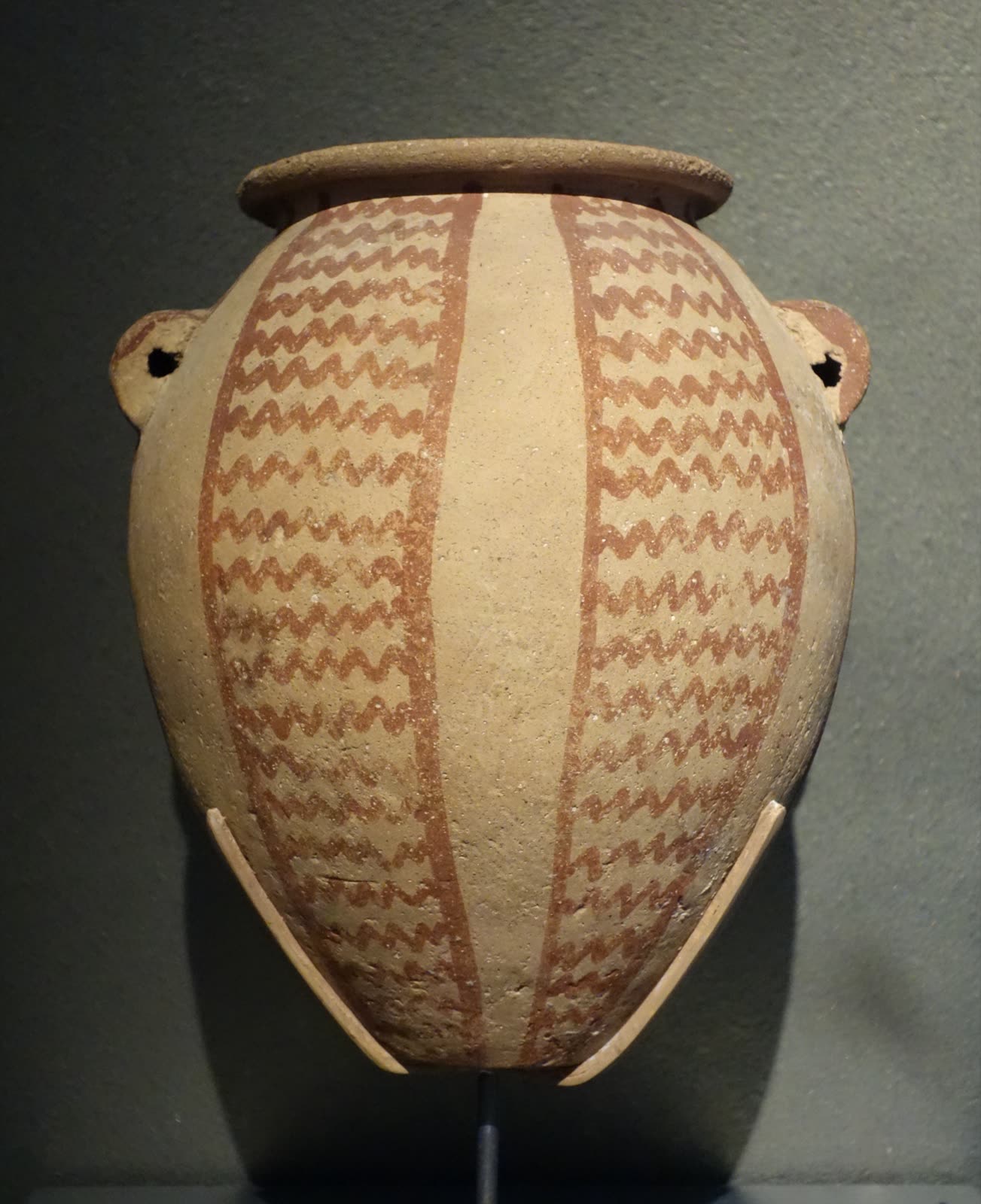

The file title and museum context identify this painted pottery jar with El Adaima, the Predynastic Naqada II period and a date around 3500–3300 BC. That information belongs to the object record. The photograph allows a separate visual task: trace how dark painted marks organise the jar’s pale surface. Neither task requires guessing what every zigzag meant.
Fix the profile before the motif
Locate rim, short upper transition, shoulder, rounded body and lower taper. The widest part establishes where decoration has the greatest horizontal room. Near the shoulder and base, the surface curves away, so repeated marks appear compressed. Pattern cannot be copied accurately onto a flat rectangle without accounting for that form.
Divide the surface into bands
Look for horizontal lines that separate upper, middle and lower zones. Then identify the larger vertical or diagonal panels inside them. A band may frame the pattern, close it or provide a pause. Count only elements visible enough to distinguish; part of the sequence continues around the hidden back.
Pattern map
Top boundary → panel width → zigzag direction → separator → lower boundary. Mark the side edges “continues” rather than inventing the unseen rear design.
Trace one zigzag as a path
Follow a single line from turn to turn. Note whether spacing is regular, whether the stroke thickens and where it meets a panel boundary. Hand-painted repetition can include variation without becoming random. Camera focus, surface abrasion and curvature can exaggerate or conceal differences.
A zigzag can resemble water, mountains, textiles or many other forms to a modern viewer. Resemblance is not interpretation. Use scholarly museum material before assigning symbolic meaning.
Negative space is part of the design
The unpainted ground between strokes controls legibility. Compare narrow internal gaps with broader pauses between panels. A high-contrast photograph can make the dark paint expand and shrink pale space; examine the original museum image and object record when precise proportions matter.
Pattern follows a three-dimensional rhythm
As the jar turns, panels disappear at one edge and enter at the other. A slow change of viewer position, when permitted, reveals this rhythm better than rotating the object. Museum objects must never be moved by visitors. A sequence of photographs from allowed positions can show continuity without touching the case or display.
Wear interrupts but does not erase
Faded paint, surface loss and small chips can break a line. Do not digitally repair the motif unless the image is explicitly labelled as a reconstruction. Record where the pattern is visible, uncertain or missing. The interruption can reveal how the design was placed and how the vessel survived.
Colour is a camera problem too
Lighting, white balance and display glass affect the pale ceramic body and darker paint. A warm museum light may shift the ground toward cream or orange. Preserve a believable range and avoid using saturation to prove a pigment identification. Material and pigment terms belong to conservation analysis or the museum record.
The date belongs to this object record
Its Predynastic attribution does not transfer to a modern jar with zigzags, nor does a repeated motif prove direct cultural continuity. Compare exact features—panel division, line direction, profile placement—while keeping makers, dates and contexts separate.
Scale the drawing honestly
Without a provided measurement, the photograph should not be used to state exact height. The display and camera crop can make a modest jar monumental. If the museum catalogue supplies dimensions, cite them; otherwise discuss proportions such as opening relative to body.
Write the caption in two halves
First retain the supported museum facts: object name, place, period, approximate date, material and collection. Then add the visible description: rounded jar with dark zigzag panels arranged between bands. This structure prevents a poetic pattern reading from replacing the record.
The jar rewards disciplined attention. Its pattern travels around a form, changing spacing and visibility as the surface turns. Meaning may remain debated or unavailable, but placement, rhythm and preservation still provide a rich, honest account.