Note 02 / reflective ceramic
Fustat: lustre and surface
Metallic-looking decoration changes with viewpoint. A careful reading separates the object’s layers from glass reflections, exposure and museum repair.
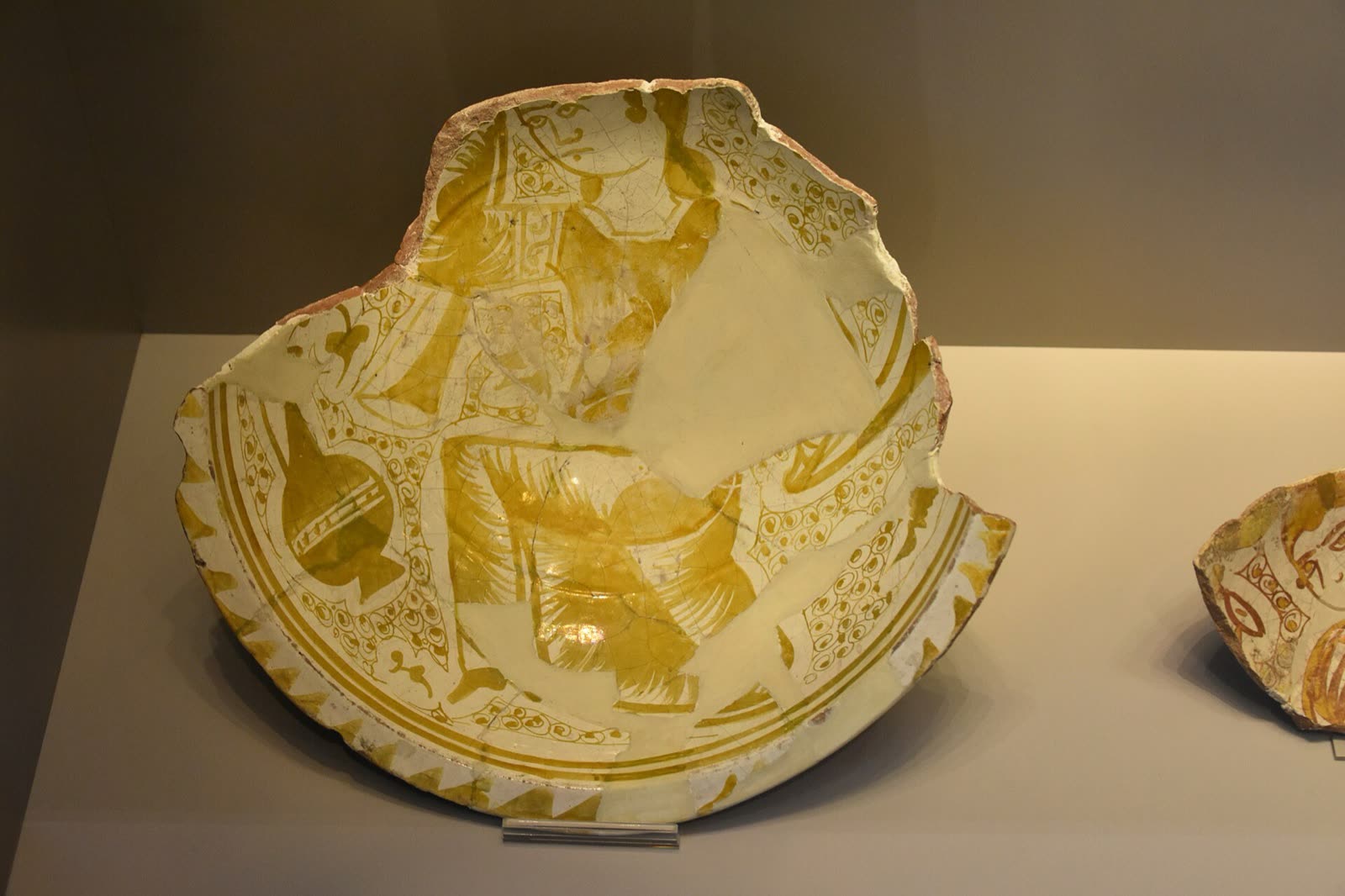
_(26353891838).jpg)
The source record for this photograph identifies lustreware from tenth-century Fustat in the Pergamon Museum. That record supplies place, broad date and collection context; the image supplies a particular view under museum lighting. Reading the two together is more reliable than treating brown-gold shine as self-evident proof of technique, age or condition.
Build the surface as layers
Begin with the ceramic body where a break, edge or uncoated area makes it visible. Above that may sit a slip or glaze, and decoration can occupy another layer. Conservation joins, fills or coatings may be present too. A photograph can show differences in colour and sheen, but it rarely reveals the complete technical sequence. Use the museum catalogue for material terminology.
Five-zone surface map
Base field → decorated mark → exposed edge or break → repaired join → reflected light. Mark each separately so reflection is not copied as ornament.
Lustre responds to viewpoint
Lustre decoration can produce a metallic appearance on a glazed ceramic surface. Its visible strength changes with the angle between light, object and observer. One part may look dark brown while another catches gold or copper-like brightness. A second photograph from another angle can record the change without implying that the colour itself changed.
Do not use flash where prohibited or press close to display glass. Reflections of lights, phones and visitors can imitate bright marks on the vessel.
Separate motif from glare
Trace repeated lines and enclosed shapes across the object. Decoration usually follows the form, while glare may cut across motif boundaries or duplicate a ceiling light. Compare both sides and look for continuation behind a reflection. When the mark remains uncertain, label it as obscured rather than digitally completing the pattern.
Wear interrupts several layers
Abrasion, loss and burial or handling history can expose different levels of the surface. A pale patch may be missing decoration, altered glaze, a fill or simply strong light. Edge shape and museum documentation help, but a general photograph is not enough to diagnose deterioration.
Avoid value language such as “damaged beyond recognition.” Loss can make manufacture visible and may be part of the object’s archaeological history. Conservation specialists determine condition and treatment.
Joins tell a museum history
Many archaeological ceramics survive as fragments and may be reassembled or supported for display. A line through the surface can be an ancient break, modern join, painted integration or shadow. Do not criticise or celebrate a restoration from appearance alone. Describe the visible line and consult the object record when the intervention matters.
Form changes the decoration
A bowl, plate or jar curves away from the viewer, compressing marks near the edge. Photographing from above may clarify the interior design but distort wall height; a side view restores profile but hides the centre. Two complementary frames are more honest than forcing one image to provide both plan and elevation.
Fustat is context, not a style label for everything
The source identifies this object with Fustat. That does not make every brown-and-gold ceramic “Fustat ware,” nor does visual resemblance establish excavation place or date. Production, circulation and collection histories require specialist evidence. Keep the source location attached to this record rather than exporting it to unrelated objects.
Lighting belongs in the caption
If reflections strongly shape the image, note that it was photographed in a museum display. Adjusting exposure for readability is different from recolouring the surface. Heavy processing can remove real variation or invent a uniform sheen, so retain a natural tonal range and disclose significant edits.
End with two descriptions
First write the object record: lustreware, Fustat, tenth century, current museum as supplied by the source. Then write the visible surface: dark curving marks, lighter glazed field, breaks, joins and reflected highlights. Keeping the two descriptions separate makes both stronger.
Lustreware rewards movement because light changes the reading, but the museum object should not be moved to produce it. Let the observer and camera change position only where permitted. The surface remains under the care of the collection.