Note 01 / ceramic form
How to read a vessel by profile
A vessel is a continuous sequence from opening to base. Describe each turn in that sequence before assigning a function, period or place.
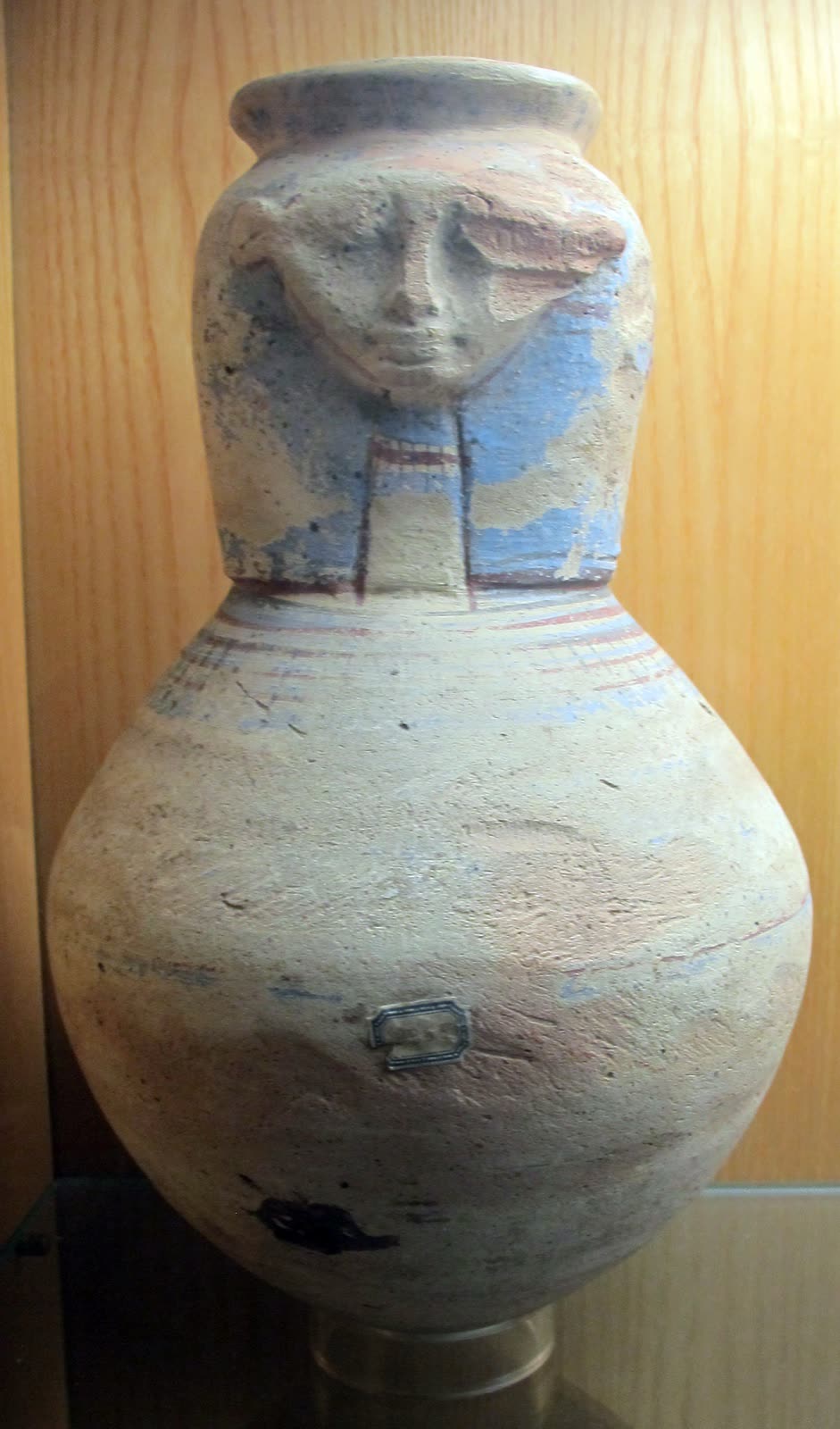

Vessel names are convenient but can make observation too fast. “Jar,” “bowl” and “bottle” compress several visible decisions into one word. A profile reading works in the opposite direction. It starts at the opening, follows the wall through every expansion and contraction, and ends where the object meets a support. The method applies to complete pots and fragments, while date, provenance and function remain questions for an authoritative object record.
Begin with the opening
Observe whether the opening is broad relative to the body or noticeably restricted. Then look at the rim: rounded, flattened, thickened, folded outward or difficult to see because of the camera angle. A rim is more than the last centimetre of clay. It controls the transition between interior and exterior and may preserve useful form when the rest of a vessel is missing.
Do not infer pouring, storage or drinking from opening size alone. Covers, stoppers, contents and use-wear require other evidence.
Follow neck into shoulder
A neck is a narrower wall below the rim, but not every vessel has a separate neck. Some expand immediately into the body. Where a neck is visible, note whether the change into the shoulder is sharp, stepped or gradual. The shoulder is the outward turn toward the vessel’s greater width; it can be high, low or almost absent.
Five-line profile sketch
Opening width → rim direction → neck length → widest body point → base contact. Draw only the visible side and mirror it with a dotted line if symmetry is an assumption rather than a measured fact.
Locate the widest point
The body may be widest near the shoulder, around the middle or lower down. That position changes the vessel’s visual weight. Compare it with total height only when the image is close to level. A camera looking down enlarges the opening; a low view enlarges the lower body. Museum mounts and neighbouring objects can also hide the true outline.
Use plain curve language—rounded, tapering, nearly straight, swelling—before technical typology. Those words remain useful even when classification is uncertain.
Read handles as attachments
If handles are present, trace both attachment points and the space inside the loop. A handle can bridge rim to shoulder, sit on the body or appear only as a lug. One hidden handle may make a symmetrical pair look single. A photograph cannot establish how much weight the attachment once carried or whether it is original, repaired or restored unless the record says so.
End at the base
Some vessels stand on a flat base or foot; others have rounded or pointed lower forms that required a support or different placement. Display mounts can create an artificial foot. Look for the actual clay edge and shadow, but do not reach behind a museum object or lift a workshop piece to check. The underside is part of the record only when responsibly visible.
Surface does not equal clay body
Exterior colour may come from the ceramic body, a slip, paint, glaze, firing atmosphere, burial, cleaning, conservation or photography. A red-looking vessel is not enough to identify a clay source. Likewise, smoothness can result from coating, polishing or image resolution. Describe hue range and sheen while keeping material claims tied to a record or maker.
Fragments preserve partial profiles
A rim sherd keeps opening and lip information; a base fragment keeps the contact point; a body sherd may preserve curve and decoration. None reconstructs the whole vessel automatically. Archaeological specialists compare fabric, manufacture, context and established typologies. A casual viewer should mark the missing section rather than drawing a confident complete pot.
Function needs more than silhouette
Size, residue, context, wear, associated objects and parallels can all affect interpretation. A narrow neck may limit access, yet that fact does not identify contents. A broad bowl-like form may support several activities. Museum labels often provide a cautious object name; retain their wording and date boundary instead of upgrading it to a vivid unsupported story.
Compare without collapsing context
Two vessels can share a rounded body while differing in period, region, material, method and use. Comparison is strongest when it names the exact common feature and then lists the separate records. “Both widen below the shoulder” is an observation. “The modern pot continues the ancient design” is a historical claim requiring evidence.
The profile method makes ceramic form precise without pretending it is self-explanatory. Rim, neck, shoulder, body and base create a readable line. The object’s life still belongs to context beyond that line.